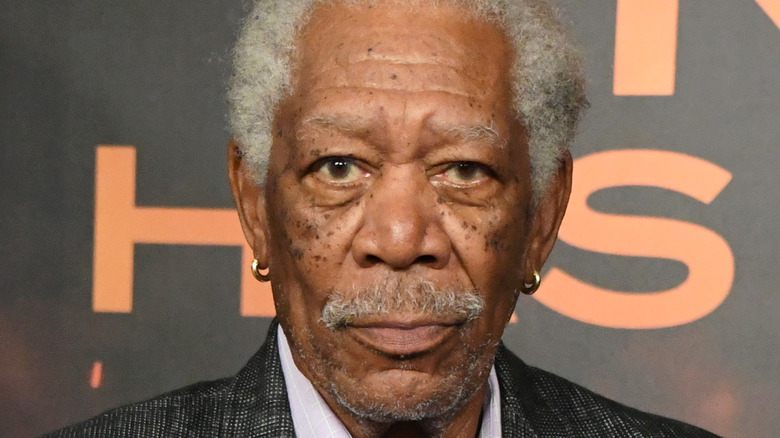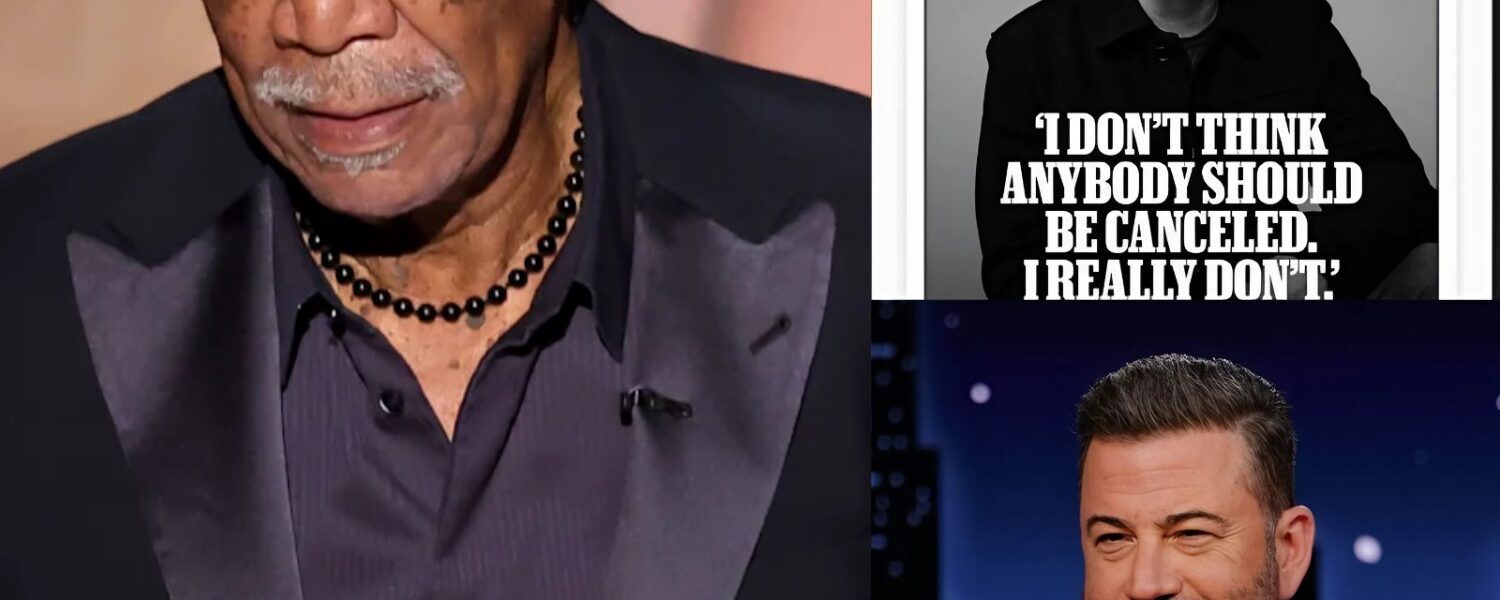
“WE WILL NOT BE SILENT” — Morgan Freeman Unleashes Fury on Jimmy Kimmel — Shockwaves Rock Entertainment Industry

The entertainment industry’s response revealed deep divisions. Within hours of
Freeman’s remarks, hashtags like #StandWithMorgan and #CancelKimmel began
trending worldwide.
Fans praised Freeman’s courage, pointing out that in an era when many celebrities
prefer to remain silent to avoid backlash, he chose to speak truth to power.
Other entertainers followed his lead.
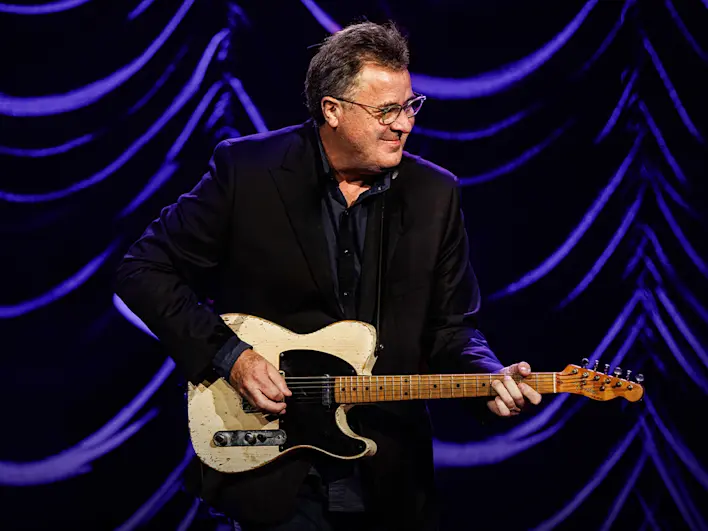
Country music star Vince Gill, actress Octavia Spencer, and even comedian Steve
Harvey publicly backed Freeman, echoing his call for empathy and respect.
“There’s a difference between comedy and cruelty,” Freeman emphasized, and his
words quickly became a rallying cry. Defenders of Kimmel argued that late-night television has always pushed
boundaries, often using humor to process tragedy.
Some accused Freeman of fueling cancel culture and stifling artistic freedom.
“Comedy is supposed to make people uncomfortable,” one writer argued in The
Hollywood Reporter.
‘If we start silencing comedians for misjudged jokes, what’s next?”
Caught in the storm, ABC was forced to act.
Under mounting pressure, the network announced the temporary suspension of
Jimmy Kimmel Live! while it reviewed the incident.
The decision sent shockwaves through the entertainment world.
For some, it was proof that corporate America was caving to mob outrage.
For others, it was a long-overdue acknowledgment that accountability applies even
to comedy’s biggest stars.
The suspension also sparked an industry-wide reckoning.
Writers’ rooms, networks, and comedians suddenly faced hard questions: where is
the line between satire and cruelty?
Can free speech coexist with empathy in a culture still grappling with grief?
And what role should public figures play in shaping that balance?

Freeman himself was clear: “This isn’t about censorship. This is about conscience.
Free speech does not mean freedom from consequences.
If you use your platform to make light of death, you must be prepared for the world
to respond.”
These words carried weight not only because of Freeman’s stature but because of
his consistency.
Throughout his career, he has been known for championing dignity, justice, and
humanity.
From his roles portraying historical leaders to his advocacy work in education and
racial equality, Freeman has long stood as a voice of reason in turbulent times.
His intervention in the Kimmel controversy was not out of character — it was the
continuation of a lifetime of moral clarity.
Public reaction reflected the power of that clarity. Clips of Freeman’s remarks were
shared millions of times.
Editorials praised his courage, with one op-ed in The New York Times declaring, “In
a culture addicted to irony, Freeman reminded us of sincerity.”
Fans flooded his social media with messages of support, many saying his words
had given them comfort in a time of division.
The debate, however, is far from over.
Kimmel’s defenders continue to warn about the slippery slope of silencing
comedians, while Freeman’s supporters insist the moment is less about censorship
and more about setting moral boundaries.
Industry insiders speculate whether Kimmel will return at all, or if his show’s
suspension marks the end of an era in late-night television.
What is certain is that Morgan Freeman’s voice has once again proven its
unparalleled resonance.
At 88 years old, he remains not just an actor or celebrity, but a cultural conscience.
In a world quick to laugh at everything — even tragedy — he reminded millions that
some things deserve solemnity, not satire.
![]()
Whether his intervention will reshape late-night comedy or simply mark a temporary
scandal remains to be seen.
But one thing is undeniable: Morgan Freeman’s stand has reignited a vital
conversation about compassion, responsibility, and the role of humor in times of
grief.
And in the end, perhaps that is the greatest legacy of his words. He did not silence
comedy.
He challenged it to be better.
He reminded the industry — and the world — that laughter should lift us, not
diminish our shared humanity.
In an age of noise, his steady voice cut through like thunder. And for once,
Hollywood listened.
caught in a firestorm after country music icon Vince Gill unleashed an emotional
and furious rebuke of late-night host Jimmy Kimmel.
At the center of the storm: Kimmel’s controversial remarks about the death of
conservative activist Charlie Kirk — words that many have condemned as cruel,
untimely, and deeply inappropriate.
What might have been just another late-night segment has now escalated into one
of the most explosive cultural showdowns of the year, with Gill emerging as the
unexpected but undeniable voice of conscience.
His four words — “We will not be silent” — have ricocheted across social media,
reverberated through the country music community, and forced Hollywood and the
television industry to confront uncomfortable questions about decency, free speech,
and the boundaries of comedy.
Vince Gill Draws the Line 
Gill, long beloved for his gentle demeanor and his ability to move audiences with
both heartfelt ballads and soaring anthems, rarely wades into controversies of this
magnitude.
But this time, he refused to remain quiet.
In a fiery social media statement followed by a series of interviews, Gill condemned
Kimmel’s comments as a “disgusting lack of humanity” and “the lowest form of
entertainment.”
His words carried the raw weight of a man unwilling to let cruelty pass for comedy.
“When a person dies, that pain is real,” Gill wrote. “It’s not material for a late-night
punchline. It’s not entertainment.
It’s heartbreak. And anyone who tries to turn grief into a joke should be ashamed.”
Gill’s words struck a chord with millions, not only because of their moral clarity but
because they came from a man known for kindness and compassion.
If Vince Gill — the consummate gentleman of country music — had lost his
patience, then surely, something had gone too far.
Fans and Entertainers Rally
The reaction was immediate.
Fans flooded Gill’s social media pages with praise, thanking him for having the
courage to speak when so many others in the entertainment industry remained
quiet.
Hashtags like #/VeWilINotBeSilent and #StandWithVince began trending within
hours.
Other entertainers soon joined the chorus.
Country artists, television personalities, and even some Hollywood actors
expressed their agreement, saying that Kimmel had crossed a sacred line.
For many, Gill’s words became a rallying cry: a reminder that entertainment does
not exist in a vacuum, and that even comedians have a responsibility to show
empathy when tragedy strikes.
ABC Suspends “Jimmy Kimmel Live!”
:max_bytes(150000):strip_icc():focal(999x0:1001x2)/Jimmy-Kimmel-db432376425b4b04a35852ec4fbd70b9.jpg)
As the outrage built, pressure on ABC and its parent company, Disney, intensified.
Within days, executives made the stunning announcement: “Jimmy Kimmel Live!”
would be suspended indefinitely.
The decision sent shockwaves across the industry. Some hailed it as accountability
long overdue.
Others called it a dangerous precedent and warned that comedians everywhere
would now fear retaliation for pushing boundaries.
For Gill, however, the suspension was not about politics or censorship — it was
about basic human decency.
“There’s a difference between comedy and cruelty,” he emphasized in a later
interview. “Free speech is a right.
But freedom from consequences? That doesn’t exist. We’re all responsible for the
words we speak.”
A Divided Entertainment World

The fallout has left the entertainment world more divided than ever.
Kimmel’s defenders argue that comedy has always thrived on sharp edges and
uncomfortable truths, and that punishing a comedian for an ill-timed joke amounts to
an attack on artistic freedom.
Some went so far as to accuse Gill of fueling “cancel culture,” insisting that
audiences should simply change the channel if offended.
But Gill’s supporters counter with equal force. To them, this is not about cancel
culture but about accountability.
They argue that laughing at death — especially in the raw days following a tragedy
— is not satire, but cruelty dressed as entertainment.
Gill’s refusal to stay silent has emboldened many who feel the industry too often
prioritizes ratings over respect.
The Larger Question
At its core, this clash between Vince Gill and Jimmy Kimmel is about something
bigger than two men in very different corners of entertainment.
It’s about whether our culture is willing to tolerate cruelty if it makes us laugh, and
whether humanity has a place in industries built on spectacle and profit.
Gill’s words have forced uncomfortable reflection: Do we want a society where
anything is fair game for a punchline?
Or do we draw the line at tragedy, giving space for grief before turning it into
content?
Vince Gill’s Voice of Conscience
For Vince Gill, the answer is clear.
“We will not be silent,” he repeated in one interview, his voice carrying both sorrow
and fire.
‘If it takes a country singer to remind people that death deserves respect, then so
be it.
Some things matter more than ratings, more than politics, more than a laugh.”
And so the debate rages on — not just in Hollywood boardrooms and country music
circles, but in living rooms, social feeds, and news outlets across the nation.
Jimmy Kimmel’s career hangs in the balance. ABC and Disney face mounting
pressure from both sides.
But perhaps the most lasting impact will be Vince Gill’s decision to speak, to stand,
and to remind a fractured culture of the one truth that should transcend all divisions:
humanity must come first.

Conclusion
What began as a late-night monologue has spiraled into a defining moment for
American entertainment. Kimmel’s defenders cry censorship.
Gill’s supporters hail accountability.
And in the middle stands Vince Gill, a man who rarely enters political fights but now
finds himself leading a moral one.
No matter where the debate lands, one thing is certain: the words “We will not be
silent” will echo long after the cameras stop rolling.
In a world too often numb to cruelty, Vince Gill’s stand has jolted the industry awake
— and forced us all to ask what kind of voices we will allow to shape the culture of
tomorrow.