The View erupted into chaos as Jamal Roberts slammed the panel with unfiltered truths, leaving Whoopi and the audience stunned

LIVE-TV CHAQOS: JAMAL ROBERTS SHATTERS THE VIEW
It started as an ordinary taping of The View, but within minutes, the studio
transformed into ground zero for what television insiders are calling one of the most
explosive live moments in daytime history.
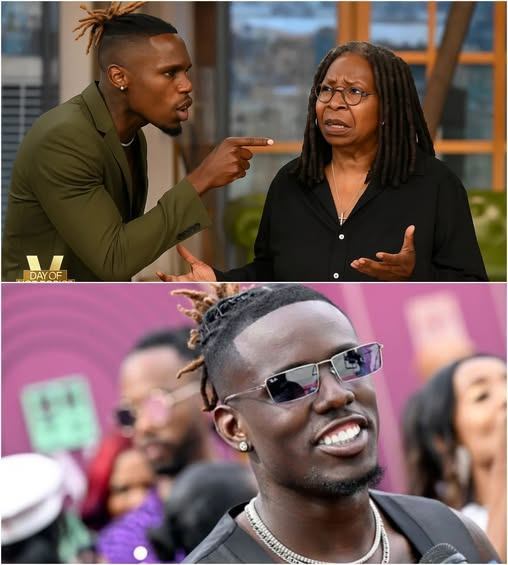
The second Whoopi Goldberg screamed, “CUT IT! GET HIM OFF MY SET!” it
was already too late.
Jamal Roberts, a man known for his powerful, soulful presence and his
uncompromising voice, had already turned the broadcast upside down.
Every camera was rolling, capturing each tense second, each word that would send
shockwaves across the internet within moments.
What made this incident so remarkable was not just the intensity of the
confrontation, but the clarity of purpose behind Roberts’ words.
With a finger pointed squarely at Whoopi, he fired back, “YOU DON’T GET TO
LECTURE ME FROM BEHIND A SCRIPT!”
His voice, familiar to fans for its stirring gospel performances and heartfelt ballads,
thundered across the studio, shaking the very walls of the set.
It was a performance of defiance, conviction, and raw emotion, all rolled into one.

The audience froze. Some mouths gaped open, others gripped the edge of their
seats.
The panel, long accustomed to the predictable ebb and flow of daytime chatter, sat
in stunned silence, unsure whether to react or retreat.
And then, as if breaking a dam, the eruption came.
Jamal’s declaration cut through the tension like lightning: “I’M NOT HERE TO BE
LIKED — I’M HERE TO TELL THE TRUTH YOU KEEP BURYING!”
Ana Navarro, one of the more outspoken voices on the panel, immediately lunged,
branding him “toxic.”
But Roberts’ focus remained unbroken. “TOXIC IS REPEATING LIES FOR
RATINGS.
| SPEAK FOR PEOPLE WHO ARE SICK OF YOUR FAKE MORALITY!” he fired,
each word landing like a hammer.
For a few frozen moments, the studio was silent but for the echo of his voice, heavy
and uncompromising, each syllable reverberating in the minds of everyone
watching.
What followed cemented the moment as live-TV infamy.
Roberts, with a mix of calm determination and controlled fury, pushed back his
chair, leaned over the panel’s glossy desk, and hurled his parting shot: “YOU
WANTED A CLOWN — BUT YOU GOT A FIGHTER.
ENJOY YOUR SCRIPTED SHOW. I’M OUT.”
He walked off with a measured, yet defiant pace, leaving behind a studio in
shambles—papers scattered, cameras still rolling, the air thick with disbelief.
Social media erupted instantly. Hashtags related to the incident trended worldwide
within minutes.
Viewers split down the middle: some hailed Roberts as a hero, a voice of
authenticity and courage, while others decried the chaos, labeling it a disruption of
civility and decorum.

Behind the scenes, producers scrambled. Directors frantically signaled to cut feeds
or transition to commercials.
Staff whispered urgently among themselves, trying to regain control of a situation
that had clearly escaped any form of scripting.
The tension was palpable, a mix of awe, fear, and the realization that the
predictable structure of daytime television had been irrevocably broken.
Media analysts quickly weighed in.
Commentators described the event as a “new era for live television,” one where
truth and raw emotion collide with expectation and tradition.
Roberts’ actions, they argued, reflected a growing public appetite for authenticity
over performance, for confrontation over passive dialogue.
It was a reflection of society’s broader frustrations, aired in real time before millions
of viewers.
Fans of Roberts’ music and public persona celebrated his fearless approach.
Many noted that his background in gospel music and heartfelt ballads gave him a
stage presence unlike anyone else on daytime TV.
His ability to command attention, to pivot emotion into action, and to use his voice
as a weapon for truth, was a performance that would be analyzed, celebrated, and
debated for years to come.
But the impact was more than just entertainment.
Cultural critics highlighted how the incident forced conversations about ethics,
integrity, and accountability in media.
What does it mean when scripted platforms are challenged by unfiltered voices?
Who decides what is acceptable discourse in a space designed for both opinion
and entertainment?
Roberts’ confrontation with Goldberg was more than a personal clash—it was a
lightning rod for discussions about authenticity, power dynamics, and the moral
responsibility of those who speak to millions every day.
For those who witnessed it live, the incident was electrifying.
The combination of raw emotion, physicality, and verbal mastery created a moment
that will be replayed in clips, memes, and commentary for years.
The phrase “You wanted a clown, but you got a fighter” quickly became emblematic
of resistance against constrained narratives, a rallying cry for viewers hungry for
voices that refuse to be silenced.

As the dust settled, one fact remained clear: Jamal Roberts had done more than
just walk off The View.
He had redefined the boundaries of daytime television confrontation, proving that
even the most controlled, scripted environments are vulnerable to the power of
conviction and courage.
His exit was not an end but a statement—a declaration that truth, passion, and
authenticity can—and will—disrupt the status quo.
Whether loved or criticized, Roberts’ actions left an indelible mark.
The studio may have returned to its normal routine, but the echoes of that
confrontation reverberate far beyond the confines of television screens.
For audiences, it was a reminder that real voices, when amplified, can shatter
expectation, ignite debate, and create history in the most unexpected of places.