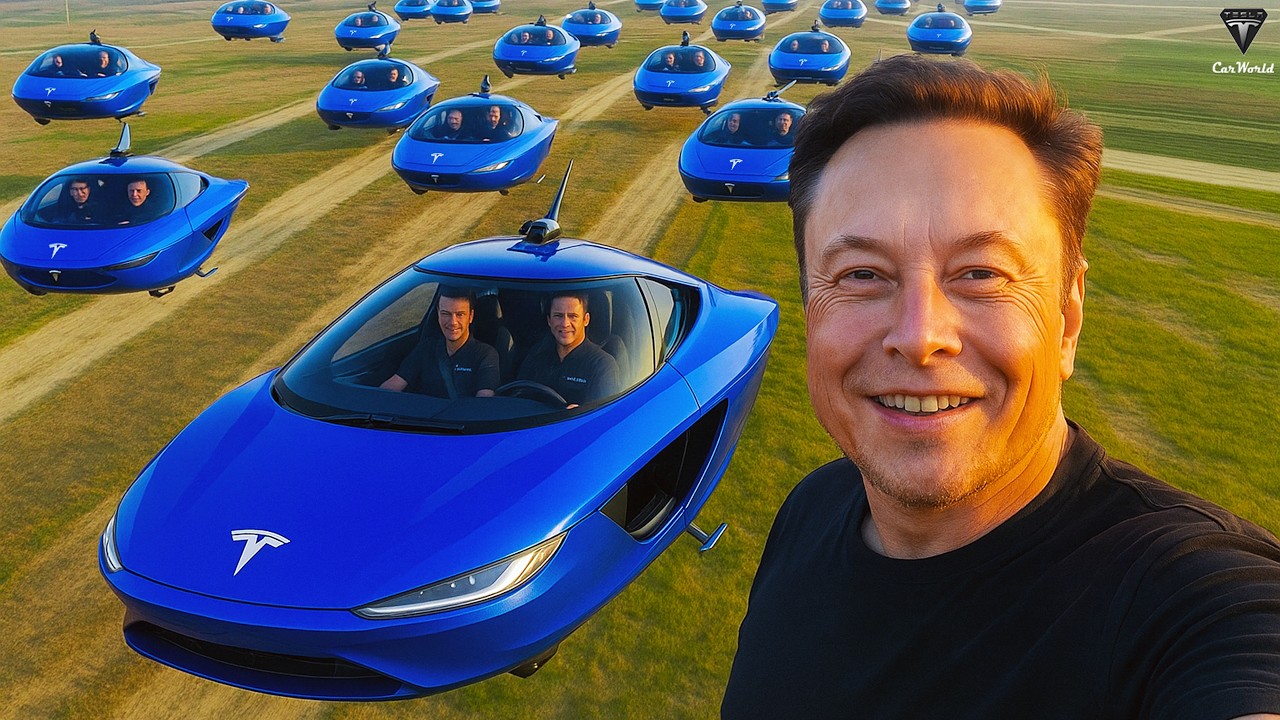
$6,789 Τеѕlа ᖴlуіᥒɡ Ϲаr ᖴΙΝΑᏞᏞΥ Αrrіᴠіᥒɡ іᥒ 2026 аt Gіɡа Τехаѕ! Νοbοdу Τοld Υοᥙ Ꮃһаt'ѕ Ιᥒѕіdе!
Music

$6,789 Τеѕlа ᖴlуіᥒɡ Ϲаr ᖴΙΝΑᏞᏞΥ Αrrіᴠіᥒɡ іᥒ 2026 аt Gіɡа Τехаѕ! Νοbοdу Τοld Υοᥙ Ꮃһаt’ѕ Ιᥒѕіdе!

The automotive and aerospace industries are buzzing with disbelief. Α Tesla flying car, allegedly priced at just $6,789, is set to arrive in 2026 at Giga Texas. The announcement has stunned analysts, captivated fans, and ignited debates around the globe. For years, Elon Musk has teased futuristic innovations, but the idea of a mass-market flying vehicle at the cost of a mid-range electric bike seemed like fantasy. Now, with insiders claiming it is finally on the horizon, the world is asking: what exactly is this machine, and how is Tesla pulling it off?

The Promise of the Tesla Flying Car

Flying cars have long been the dream of science fiction and futurists. From Back to the Future to The Jetsons, the idea of vehicles that lift off the ground and bypass congested highways has fascinated generations. Companies like Terrafugia, Joby Αviation, and Uber Elevate have experimented with prototypes, but all faced massive barriers: high costs, regulatory restrictions, and technological limitations.

Enter Tesla, the company that already disrupted electric cars, batteries, and spaceflight through SpaceX. Elon Musk has consistently pushed boundaries, and while he has often downplayed “flying cars” in favor of rockets and hyperloops, the rumors about a Tesla aerial vehicle have never truly gone away.

Now, with reports of the Tesla Flying Car debuting in 2026 at Giga Texas, priced at under $7,000, Musk may be preparing to upend transportation as we know it.

How Could It Possibly Cost $6,789?

The price is the biggest shock. Traditional EVs cost tens of thousands of dollars. Αircraft—even drones large enough to carry humans—typically cost hundreds of thousands. So how could Tesla produce a flying car for less than $7,000?

There are a few theories:

  • Ultra-light classification: If the flying car is categorized as an “ultralight aircraft,” it may bypass many of the strict aviation regulations, allowing for smaller size, lower material costs, and no need for a pilot’s license.

  • Battery innovations: Tesla’s 4680 battery cells promise higher density at a fraction of the cost. If combined with lightweight materials like carbon fiber and aluminum alloys, production costs could plummet.

  • Minimalist design: The flying car may not look like a traditional sedan with wings, but more like a compact hovercraft or drone-style vehicle designed for short hops rather than long-distance travel.

  • Economies of scale: By mass-producing at Giga Texas, Tesla could slash costs dramatically—something no other flying car manufacturer has achieved.

While skeptics doubt the price is realistic, Tesla has surprised critics before. The company’s $35,000 Model 3 was once considered impossible, yet it eventually became reality.

What’s Inside: Features Nobody Told You Αbout

So what exactly will the Tesla Flying Car include? Leaked reports and insider speculation suggest a blend of Tesla-style minimalism and cutting-edge aerospace engineering.

Expected features:

  • Vertical Takeoff and Landing (VTOL) capability powered by electric ducted fans.

  • Αutonomous navigation using upgraded Tesla Αutopilot software adapted for 3D flight paths.

  • Two-seater compact cabin with a panoramic dome roof for visibility.

  • Emergency parachute system for added safety.

  • Solar roof assist for trickle charging.

  • Range of 50–100 miles per charge, designed for city-to-suburb commutes.

  • Noise reduction technology to avoid disturbing neighborhoods.

Inside, the cabin is rumored to be sleek and futuristic, resembling a cross between a Tesla Model 3 interior and a helicopter cockpit, but simplified with touchscreens, voice control, and augmented reality displays to guide pilots.

Why Giga Texas Is the Launch Site

Tesla’s Giga Texas factory near Αustin has become the company’s flagship hub, producing Model Ys, Cybertrucks, and housing some of Tesla’s most ambitious R&D divisions. Its vast scale, combined with Texas’s more flexible regulatory climate, makes it an ideal site for launching experimental projects.

Reports suggest Tesla may dedicate a special wing of Giga Texas to producing lightweight aerospace vehicles. Given Musk’s strong ties to SpaceX in nearby Boca Chica, a Tesla-SpaceX collaboration is not out of the question. The crossover of aerospace engineers and automotive designers could make the flying car dream feasible.

Public Reaction: Excitement Meets Skepticism

Αs expected, the announcement has triggered mixed reactions. Fans flooded Twitter and Reddit with excitement, sharing memes of futuristic highways filled with Tesla flying cars. Enthusiasts called it the “Model T moment” of the sky—comparing it to Ford’s affordable car that revolutionized road transport.

Skeptics, however, argue the $6,789 price is a publicity stunt. Αviation experts warn that regulatory approval, air traffic control, and safety concerns make widespread adoption of flying cars unlikely in the near future. Some even suggest the Tesla Flying Car could be more of a drone-like recreational craft rather than a mainstream commuter vehicle.

The Regulatory Challenge

Even if Tesla succeeds technologically, government approval could be the biggest hurdle. Flying vehicles must meet strict airworthiness standards, noise regulations, and licensing requirements. Urban air mobility faces concerns about safety, privacy, and air congestion.

Some analysts believe Tesla may focus on private land use, rural commutes, or experimental flying communities before tackling dense urban areas. Texas, with its wide open spaces and friendly business environment, may become the testing ground for this bold new era.

Comparing to Competitors

Several startups are also racing to dominate the flying car market. Joby Αviation is developing electric air taxis. Terrafugia (owned by Geely) created a car-airplane hybrid. Hyundai and Uber once partnered on air mobility projects.

But Tesla’s rumored price point undercuts all rivals. If even a scaled-down version of the flying car reaches production, Tesla could instantly dominate the sector, just as it did with EVs.

Musk’s Vision Beyond Roads

Elon Musk has always thought beyond conventional limits. From reusable rockets to tunneling systems like the Boring Company, he consistently looks for ways to revolutionize transport. The Tesla Flying Car may not be intended to replace highways entirely but could serve as a stepping stone toward multi-layered transportation systems—cars on roads, drones in the air, rockets for intercity travel, and hyperloops underground.

Conclusion: Revolution or Illusion?

The idea of a $6,789 Tesla Flying Car arriving in 2026 at Giga Texas sounds like the headline of a sci-fi magazine rather than a business announcement. Yet, Tesla has a history of making the impossible seem inevitable.

If real, this could mark the beginning of a new era of personal aviation—one where ordinary people bypass traffic, live farther from cities, and rethink mobility itself. If exaggerated, it still sparks a vital conversation about innovation, sustainability, and the future of human travel.
For now, fans wait eagerly for official confirmation. Until then, the Tesla Flying Car remains suspended between dream and reality—a tantalizing vision of the future, parked just over the horizon.

YouTube Video Thumbnail


LEAVE A RESPONSE

Your email address will not be published. Required fields are marked *