“It Wasn’t Supposed To Happen This Way” — Tyler Robinson Finally Tells The Truth In Court, And The Name He Revealed Changed Everything Candace Owens Thought She Knew…

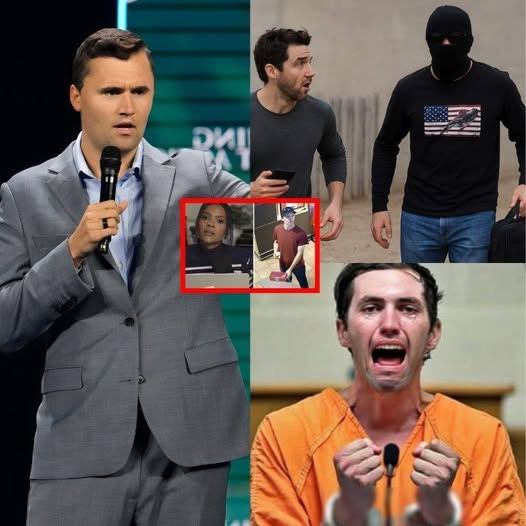
The air inside Courtroom 7B was electric — a thick, pulsing silence that seemed to hum beneath the marble arches. Every journalist, every camera operator, every political commentator in the nation had their eyes fixed on the man sitting at the witness stand. Tyler Robinson. Once an obscure communications aide buried deep within the machinery of conservative media — now the most watched man in America.
For weeks, his trial had been called many things: a whistleblower hearing, a political theater, even a morality play for the digital age. But when Robinson finally broke his silence and spoke the name, everything that Candace Owens — the conservative firebrand who prided herself on being untouchable — thought she knew, began to crumble.
“It wasn’t supposed to happen this way,” Robinson whispered. “But you can’t bury the truth forever.”
And with that, the storm began.
The Scandal That Shook the Conservative Media Sphere
At the heart of this trial lies a tangled web of politics, media, and loyalty — one that exposes the fragility of alliances built not on conviction, but on control.
Tyler Robinson had joined Candace Owens’ media network in 2020, during the height of America’s ideological civil war. Bright, articulate, and hungry to make a difference, Robinson was recruited to help shape messaging, manage internal research, and assist with confidential “truth projects” — the kind of investigative content Owens claimed would “expose the corruption of the mainstream narrative.”
But somewhere along the way, that mission twisted. According to court documents and testimony from Robinson’s defense team, what began as a pursuit of transparency evolved into something darker — a campaign of manipulation and selective storytelling, where facts were bent, edited, and weaponized to sustain outrage and protect allies.
“Truth became strategy,” said defense attorney Dana Marks during opening arguments. “And in that environment, there are no heroes — only survivors.”
The Moment the Room Froze
When Robinson took the stand last Friday, no one expected fireworks. For days, he’d sat quietly beside his attorneys, expression unreadable, his every move analyzed by a media ecosystem both salivating for scandal and terrified by what it might reveal.
Then, under oath, he began to speak.
“They told me to take the fall,” Robinson said softly, his voice steady but his hands trembling. “They said it would protect the movement — that it was for the greater good. But I was never told whose good that really was.”
The prosecutor pressed him: Who told you that, Mr. Robinson?
The pause that followed lasted seconds but felt eternal. The crowd leaned forward, breathless.
Then, the words fell like a hammer.
“Candace Owens.”

Gasps rippled through the courtroom. A few reporters dropped their pens. And in that single moment, years of ideological certainty seemed to fracture.
Candace Owens’ Empire Under Fire
Candace Owens has built her brand on defiance — on being the voice that “says what others won’t.” Her rise from YouTube commentator to cultural lightning rod is a study in the modern mechanics of influence: charisma, controversy, and control.
She has called herself “a soldier in the war for truth.” But now, that identity faces its own reckoning.
Robinson’s accusation — that Owens personally directed him to conceal evidence and manipulate communications to fit a preordained narrative — strikes at the very foundation of her credibility. If true, it undermines the authenticity that fuels her power.
Her team was quick to respond. Within hours of Robinson’s statement, Owens’ legal representatives issued a sharp rebuttal:
“Mr. Robinson’s allegations are categorically false. This is a politically motivated performance by a disgruntled former contractor. Candace Owens has never instructed anyone to alter or fabricate information.”
Yet the court of public opinion is not as patient as the court of law. Online, the narrative is already spiraling.
The Digital Firestorm
By midnight, #TylerRobinson and #CandaceOwens trended across social platforms. Millions replayed the clip of Robinson’s revelation — his steady tone, the way Owens’ expression flickered when he said her name.
Some defended her fiercely:
“This is a setup. They’re afraid of Candace because she tells the truth.”
Others were less forgiving:
“If even a fraction of this is real, it proves what many suspected — that outrage has been monetized, not moralized.”
The digital battlefield that Owens once commanded had turned inward. Her followers debated, argued, and splintered. Her enemies seized the moment. And somewhere amid the noise, the deeper question surfaced:
Had the movement that claimed to fight deception become the very thing it despised?
The Hidden Network and the Emails That Changed Everything
Robinson’s defense team presented a series of encrypted emails reportedly exchanged between members of Owens’ inner media circle. In them, there were references to “C.O. directives,” “narrative framing,” and “message optimization” — euphemisms that, if proven genuine, could suggest a coordinated effort to shape not just public opinion, but public reality.
The emails allegedly detailed how certain documents were to be edited before publication, how whistleblower testimony was to be “contextualized,” and how particular individuals were to be “protected at all costs.”
Robinson claims that when he expressed discomfort, he was told:
“The truth doesn’t matter if the right people lose.”
It was a chilling phrase — one that captures the moral corrosion at the heart of modern media politics.
If these claims are verified, the implications go far beyond Owens. They point to a systemic pattern — a symbiosis between fame, ideology, and manipulation where “truth” becomes a performance, not a principle.
The Psychology of Disillusionment
For many who once admired Owens, the trial represents more than a scandal. It’s a confrontation with disillusionment.
Political psychologist Dr. Amelia Ruiz describes it this way:
“We live in an age where people don’t follow parties — they follow personalities. When those personalities fail, it feels like betrayal, because they’ve become symbolic of something larger: certainty, belonging, moral clarity. That’s what makes moments like this so devastating.”
For Robinson, it’s deeply personal.
“I believed her,” he said on the stand. “I believed that what we were doing mattered — that we were fighting lies. But when the truth became inconvenient, it was me they chose to silence.”
Those words resonated far beyond the courtroom. Across podcasts, political panels, and Twitter threads, Americans debated not just guilt or innocence, but the meaning of truth in an era where reality itself can be edited, packaged, and sold.
A Fractured Movement
Inside conservative circles, the shockwaves are immense. Some allies have distanced themselves quietly, canceling joint appearances and interviews. Others have doubled down, claiming the accusations are part of a “deep-state plot” to destroy Owens.
But beneath the bluster lies a deeper fear — that the foundation of the movement itself is cracking.
Once, Candace Owens stood as the voice of ideological defiance. Now, she’s being forced to defend not just her brand, but her belief system.

As journalist Brianna Keller noted in The Atlantic:
“If the right’s most prominent truth-teller is revealed to have engineered falsehoods, it’s not just a scandal — it’s a collapse of faith.”
What Happens Next
The legal process is far from over. Robinson’s credibility will be tested under cross-examination. Owens’ lawyers are preparing a defamation counterclaim. And political pundits, sensing blood in the water, are circling the story with predatory precision.
But regardless of verdict, something irreversible has already happened. The myth of moral infallibility — the belief that one side owns the truth — has been punctured.
Robinson, for all his flaws, has forced a reckoning.
“Maybe I’m not the hero here,” he said quietly as the day ended. “Maybe I’m just the guy who finally stopped lying.”
The Bigger Picture: When Truth Becomes a Weapon
The real story isn’t just about one man’s betrayal or one woman’s downfall. It’s about the machinery behind both — the industry of outrage, the monetization of moral certainty, the echo chambers that reward conviction over honesty.
Every empire built on ideology eventually meets the moment where it must confront its reflection.
For Candace Owens, that moment has arrived.
For Tyler Robinson, it’s liberation — or exile.
And for America, it’s a reminder that truth, when weaponized, can destroy not only opponents but its own champions.
As Robinson left the courthouse, a reporter shouted:
“Do you regret saying her name?”
He stopped, turned, and after a long silence, said the words that will echo long after the verdict is read:
“No. Because it wasn’t supposed to happen this way — but maybe this is the only way the truth ever survives.”