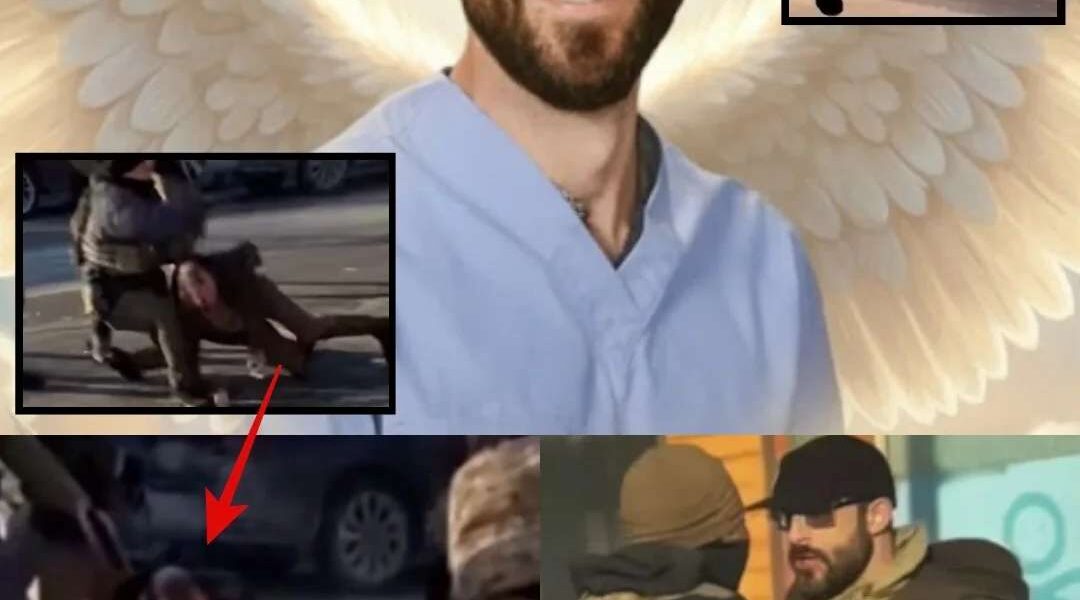




He woke before sunrise and walked through the frosty streets of Minneapolis with his breath turning to mist in the cold.
Alex Jeffrey Pretti, thirty-seven, had finished his shift as an ICU nurse caring for veterans at the VA hospital and still carried the quiet kindness that made his patients feel safe, even on their worst days.
That morning felt different, heavier somehow, as if the city itself held its breath anticipating what was to come.
He had spent years studying at the University of Minnesota, books and white coats shaping him into a healer who saw more than symptoms — he saw humanity.
In 2021, after long nights of study and practice, he had been issued his license to be a registered nurse and wore it like a promise to every person who needed him, especially those whose voices were too often ignored.
His life was one of service, not aggression, and in every step of his work he carried that purpose forward.
Yet outside the hospital walls, political storms raged, and people took to the streets to voice their frustrations with the federal crackdown on immigration enforcement sweeping through the city.
Alex understood why people protested — he saw suffering and felt compelled to act, whether inside an ICU or among crowds chanting for justice.
That day, he walked toward the gathering not as a soldier but as a concerned citizen who hoped his presence might calm tensions, even if only a little.
The protesters’ voices echoed against the brick buildings, a chorus of hope and anger stitched together by signs and whistles.
Federal agents, in heavy tactical gear, stood in rigid lines along Nicollet Avenue, their expressions hidden by helmets but their presence unmistakably authoritative.
Among the crowd, Alex felt the friction crackle, an electric tension that made every heartbeat feel louder than the one before.
A moment’s shift in the wind carried shouts and sirens, and someone near Alex was shoved to the ground by an agent’s boot.
Instinct — a nurse’s instinct — propelled him forward, not to confront but to cradle a shoulder, to lift a body off cold concrete and ease a cry of pain.
He raised his hand, phone in one palm, hoping to document rather than provoke, to bear witness to what was happening in the place he called home.
The air was thick with gas and voices folded into one another, making it hard to know where fear ended and courage began.
Alex’s mind flicked through memories — the laugh of a veteran once stabilized under his care, the thank-you cards tucked in desk drawers, moments of human connection that seemed more fragile now than ever.
He stood tall among the crowd, his badge clipped to his belt, not as a barrier but as a reminder of the life he had dedicated to others.
Federal orders crackled over radios, commands to quell what they saw as chaos, while protesters saw a crisis demanding compassion.
Agents advanced, pushing forward like a tide that respected nothing in its path, and every step brought a collective gasp from the onlookers.
For Alex, the line between what was right and what was necessary blurred, and he felt the full weight of that uncertainty in his chest.
He tried to speak, voice steady amid confusion, urging both sides to remember that each person standing there had a name, a story, a reason for being.
Yet in the swirl of motion, a scuffle broke out near him, bodies colliding in a flurry of limbs and raised voices, fear erupting like a shockwave through the crowd.
Some said he approached agents while armed, a claim both shocking and bewildering to those who knew his gentle ways, but in the chaos no one could say with absolute clarity what spark had ignited the first flash of violence.
In those moments, seconds stretched like hours, and Alex’s heart pounded with both dread and resolve.
A split-second decision by a border patrol agent, meant for defense or misread as threat, sent a bullet ringing through the tense air.
Alex staggered, confusion clouding his senses, eyes squinting against the glare of streetlights and the blur of masked figures.
His friends later said he was legally licensed to own and carry his firearm, though he never drew it — it remained holstered, a part of him that spoke more of responsibility than violence.
His only brush with the law had been a minor traffic violation years ago, a lifetime ago compared to the tragic upheaval that now shattered the morning’s fragile calm.
No serious criminal history marked his record, only a life of care and training that seemed incongruous with the tragedy unfolding around him.
The crowd recoiled, some frozen in shock, others crying out, unable to reconcile the sight of a man brought low with the ideals he had worked so hard to uphold.
Protesters surged forward, not toward aggression but toward empathy, voices rising in anguish and disbelief, echoing the collective plea for answers that seemed just out of reach.
Tears streamed down faces — some for anger, some for sorrow, all for the loss of someone they had only just grasped in his final moments.
Some tried to help him, kneeling beside his fallen form, whispering words that felt inconsequential against the weight of silence that wrapped around them.
Medics attempted first aid while distant sirens wailed, an orchestra of urgency and helplessness in the winter air.
But the life that once animated Alex’s gentle frame ebbed away, leaving behind a silence that spoke louder than any siren or shout.
In the hours that followed, Minneapolis reeled, not just from the immediate shock but from the deeper chasm it revealed about a divided nation grappling with its own reflection.
Political leaders called for calm, others for accountability, and family members struggled to understand how a man devoted to healing ended up at the center of a tragedy that would echo far beyond one city block.
A governor activated the National Guard, trying to steady a city shaken to its core, while streets that had once been filled with hope now bore the weight of grief and uncertainty.
People gathered — some to protest, others to pray — but all drawn by the stark reality that a life of service had been cut short in a swirl of confusion and conflict.
Candles lined sidewalks and makeshift memorials grew where his body once lay, symbols not just of loss but of a community’s effort to hold onto compassion in the face of chaos.
Friends spoke of him as a man who wanted to make a difference, whose voice was calm and whose hands healed, not harmed — a legacy that now seemed too profound for words alone.
Meanwhile, debate surged across airwaves and social platforms, voices clashing over interpretation and blame, each narrative shaped by perspective and pain.
Some called for justice, others for restraint, and a few wondered how a city so familiar with protest could be so unprepared for the heartbreak it now carried.
Yet among the clamor, the memory of Alex’s laughter, his dedication, and his kindness endured — a quiet yet resolute testament to the life he had lived and the hearts he had touched.
In the days that followed, people shared stories of the nurse who walked into the storm not as a combatant but as a caretaker.
They spoke of days he had spent comforting families, nights he had stayed late to ensure someone’s pain was eased before dawn, and the way his eyes crinkled when he smiled at a joke only he seemed to understand.
His name became a symbol — not of conflict, but of the profound ache that comes when a life defined by care collides with the harsh unpredictability of the world.
The city mourned, not in a single unified voice, but in countless individual echoes of loss and longing for understanding.
Some walked with signs demanding reform, others lit candles in windows, and still more reached out to loved ones with an urgency that only heartbreak cultivates.
Through it all, the memory of Alex Jeffrey Pretti — a nurse, a graduate, a community member, a man with no serious criminal history — stayed alive in each act of remembrance and solidarity.
His parents, carrying the weight of a son lost in a moment that defied the life he embodied, reminded everyone that behind every headline was a soul whose story was rich with compassion and care.
They spoke softly of his dreams and the quiet manner in which he approached the world, urging others not to let anger erase the humanity that had defined his days.
In their grief, they asked not for division but for dialogue, a chance for a city and country to reflect on what it means to protect life in all its fragile, precious complexity.
And though the streets eventually cleared and the headlines faded, the memory of that winter morning remained etched in the hearts of many.
It lingered in silent memorials, in conversations about policy and peace, in the hush that enveloped gatherings where people spoke his name with reverence and sorrow.
Alex’s legacy endured not just in the facts of his life but in the collective yearning for a world where healing, not hurt, was the first instinct of every citizen who stepped into the light of a new day.


